
“What do you do, correct Shakespeare’s grammar?”
Barbara Mowat, co-editor of the Folger editions of Shakespeare’s plays, gets this question a lot at dinner parties. Recently retired as the Folger’s Director of Academic Programs, Barbara kindly returned to the Library to deliver the 2009 Hoitsma Lecture to a fascinated crowd of docents, answering this and many other questions about what it actually means to edit Shakespeare.
Any editor, she noted, bumps immediately into the fact that all Shakespeare’s manuscripts are completely missing. For plays that only come to us in the First Folio, there is nowhere to go when a word or phrase makes no sense. For other plays, which may have been published in one or more quarto editions as well as in the Folio, the textual narrative can get complicated indeed. In fact, every play has its own history, and it can be misleading to generalize about editing Shakespeare.
Exactly 300 years ago in 1709, the first known editor of Shakespeare’s work, Nicholas Rowe, published his edition. Barbara remains fascinated by the power of Rowe’s impact even today. In his effort to reconcile the four Folio editions and 70-some quartos published by his time, Rowe also regularized character names, inserted stage directions, and wrote Dramatis Personnae lists that persisted into the 20th century.
In fact, every edition reflects its editor’s reaction to prior editions. Over the course of the 18th century, editors after Rowe gravitated back to the First Folio, viewing quartos as stolen, bungled versions. The discovery that the Folio texts of Romeo and Juliet, Much Ado about Nothing, and Midsummer Night’s Dream were simply reprints of quartos published during Shakespeare’s lifetime led to serious exploration of quarto texts and editorial efforts to judge which are “good” and which “bad.”
In modern times, some editors have argued that Shakespeare himself wrote different versions of the same play at different points in his life, others that he merely revised and edited the plays throughout his career. The “New Bibliographers” believe that different versions reflect different manuscripts circulating for different purposes—prompt books, for example, in addition to published texts.
Barbara and her co-editor Paul Werstine feel that in the end “we cannot discern where the texts come from and we just have to work with everything that comes down to us.” They start with the First Folio text, modernize spelling and verb tenses, and consult other editions to resolve the inevitable questions that arise. Much work is in revising and updating explanatory notes, because earlier ones were written for a very different educational system, when knowledge of the Bible and classics was assumed. They began work on the new Folger editions in 1989, and the first six plays were published in 1992. The last, Two Noble Kinsmen, will appear in February 2010. The hardest play to edit? It was Othello, “because two very different texts come down to us, both disasters,” says Barbara. But each play offered some challenge, because ambiguities are still being discovered and debated.
In the end, the Shakespeare that is alive and beloved among us is the product of 400 years of different editions. “People are troubled and even offended that the Shakespeare they know is an editorial construct,” Barbara laughed. “They often say, ‘But I read him in the original!’ I like to think that if they knew how much love and care we editors lavish on the works, they might not mind so much.”


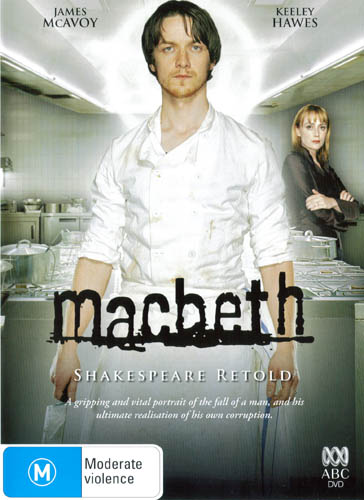 We saw ``Scotland, Pa., in which Macbeth was a frustrated fast food fry cook. Next up, the BBC's Shakespeare Retold retelling in which our protagonist is the head chef in a swanky (just got its third Michelin star!) Soho restaurant, The Nose to Tail, specializing in entrails and organs. Lady M., in black leather, is the maitre d', Macduff is the head waiter and Duncan is the jovial restaurant owner who takes credit for the fuming Macbeth's ``signature creations'' -- for example ``Pork Assortments.'' James McAvoy is the protagonist, Keeley Hawkes the wife and Richard Armitage the crafty head waiter. The witches are wised up garbage men. Said to be gruesome humor familiar to those who admire ``Scottish cop movies.'' (??) Written by Peter Moffat, who did ``Cambridge Spies'' and ``Hawking'' dramas.
